Women Face Worse Long-Term Outcomes After PMR Intervention
Women undergoing intervention for primary mitral regurgitation (PMR) are older, more symptomatic and have worse long-term outcomes than men, according to a systematic review and meta-analysis published July 21 in JACC: Cardiovascular Imaging.
Edouard Long, MSc, Rebecca T. Hahn, MD, FACC, et al., searched electronic databases for studies reporting long-term outcomes of patients undergoing surgical or transcatheter interventions for PMR, stratified by sex. Of the 17 included studies, 88% were retrospective observational studies that evaluated surgical interventions. The researchers analyzed reconstructed time-to-event individual patient data using frailty-adjusted Cox models and restricted mean survival time, then used meta-regression to assess whether sex differences in baseline characteristics contributed to variations in all-cause mortality.
Of the nearly 26,000 patients in the study cohort, 38% were women. Compared with men, women were significantly older (mean difference of three years) and were more likely to have heart failure symptoms (odds ratio, 1.8).
At nearly 16 years of follow-up, the risk of the primary endpoint of all-cause mortality was 15% higher in women than in men, corresponding to a survival deficit of about six months. Notably, sensitivity analyses restricted to surgical intervention studies produced a similar result (hazard ratio, 1.18).
For the secondary endpoint of major adverse cardiovascular events (MACE), women had a 37% higher risk than men, corresponding to 8.5 fewer event-free months based on restricted mean survival time.
Researchers identified three significant moderators of sex-related differences in mortality after PMR intervention: age, moderate or greater tricuspid regurgitation (TR) and concomitant tricuspid valve repair (TVr). Moderate or greater TR and TVr were more common among women and were associated with higher mortality compared with men. In contrast, left ventricular and left atrial parameters did not significantly influence sex-based differences in all-cause mortality.
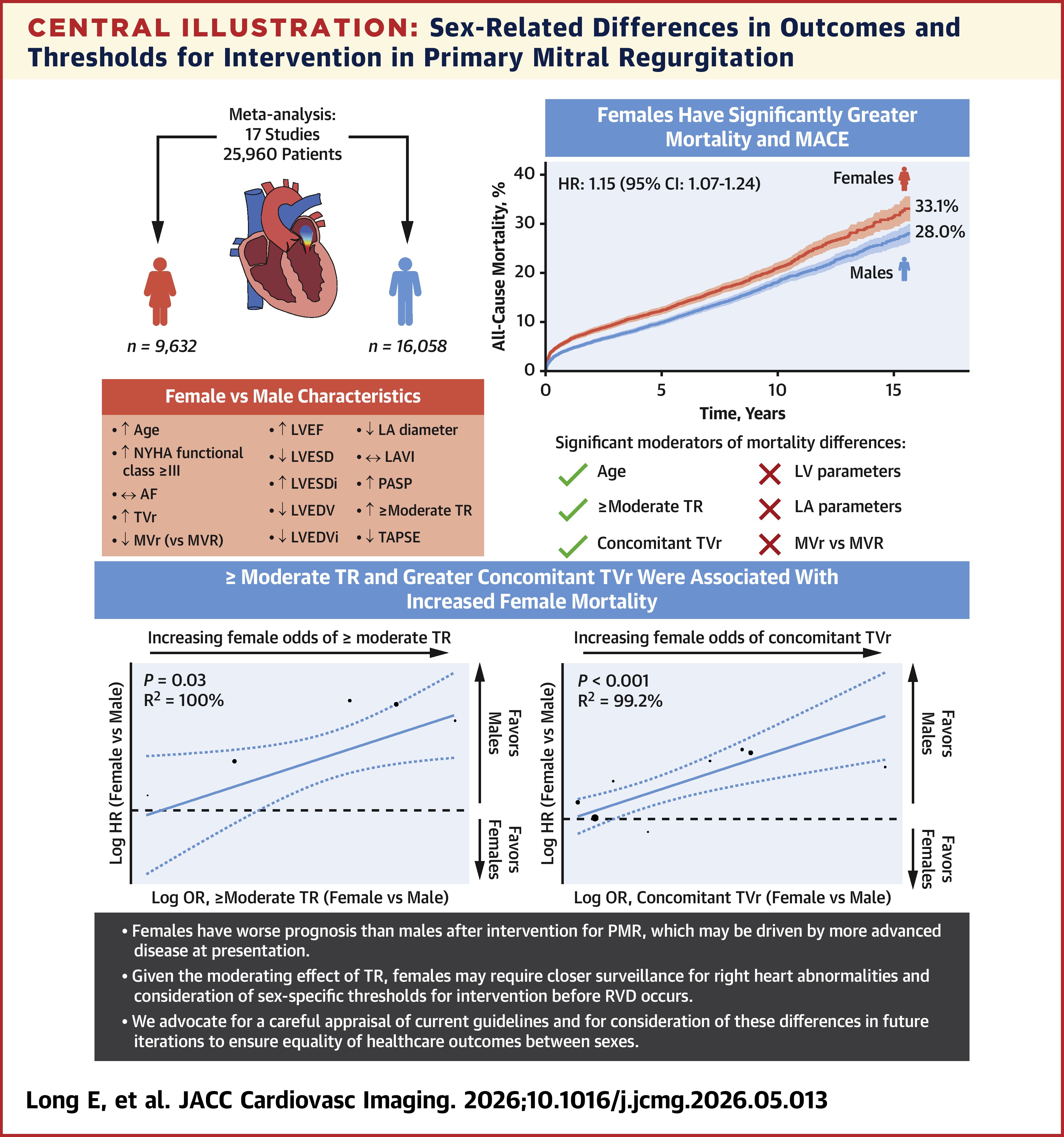
The authors describe this as the most comprehensive meta-analysis to date on sex-based differences in outcomes after PMR intervention. They emphasize that “it should not be inferred from this analysis that female sex is an independent risk factor for adverse outcome,” noting that the excess mortality observed in women “may be entirely attributable to their more advanced disease at presentation.”
They add that more studies are needed to confirm their findings and they “advocate for a careful appraisal of current guidelines and for consideration of these differences in future iterations to ensure equality of health care outcomes between sexes.”
“The finding on the presence of significant tricuspid regurgitation and concomitant tricuspid repair being a moderator of increased mortality in women is notable,” write Makoto Mori, MD, and Danial Ahmad, MD, in an accompanying editorial. “A systematic evaluation of right ventricular function, dimension and a more granular classification of tricuspid regurgitation severity may better contextualize these findings.”
Keywords: Women, Mitral Valve
